What our security headers checker analyzes
A security headers test is only useful if it covers more than the basics. Our website security headers analyzer goes beyond simple header presence checks to give you a complete picture of your site's security posture.
Security Headers
Analyzes CSP, HSTS, X-Frame-Options, X-Content-Type-Options, Referrer-Policy, Permissions-Policy, and more.
TLS/SSL Configuration
Checks protocol version, cipher suites, certificate validity, and HSTS preload status.
DNS Security
Validates SPF, DMARC, and DKIM records to identify email authentication gaps.
Cookie Security
Audits HttpOnly, Secure, SameSite, and prefix attributes on every cookie.
CSP Deep Analysis
Directive level breakdown of your Content Security Policy, flagging unsafe-inline, wildcards, and missing directives.
PDF Reports & Monitoring
Generate shareable PDF reports and set up daily monitoring to track security changes over time.
What your security report looks like
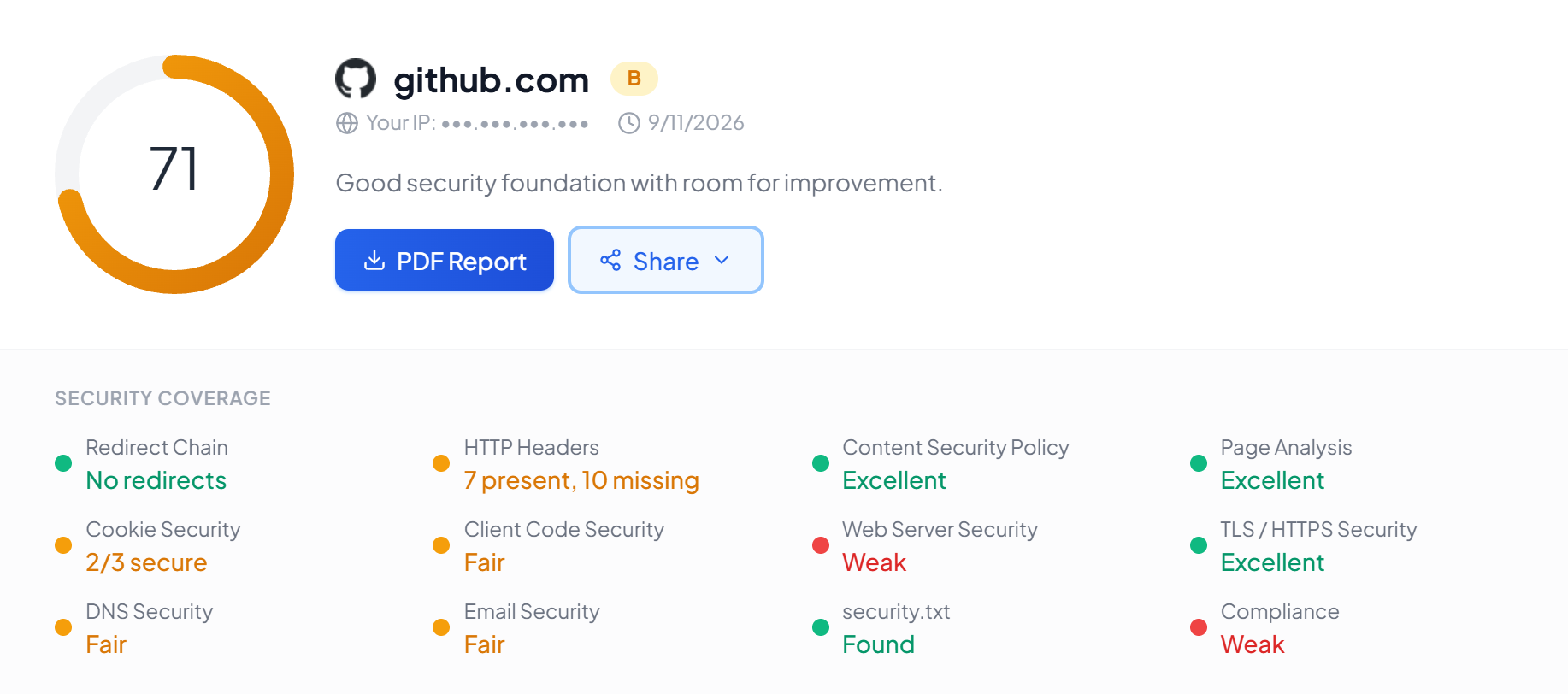
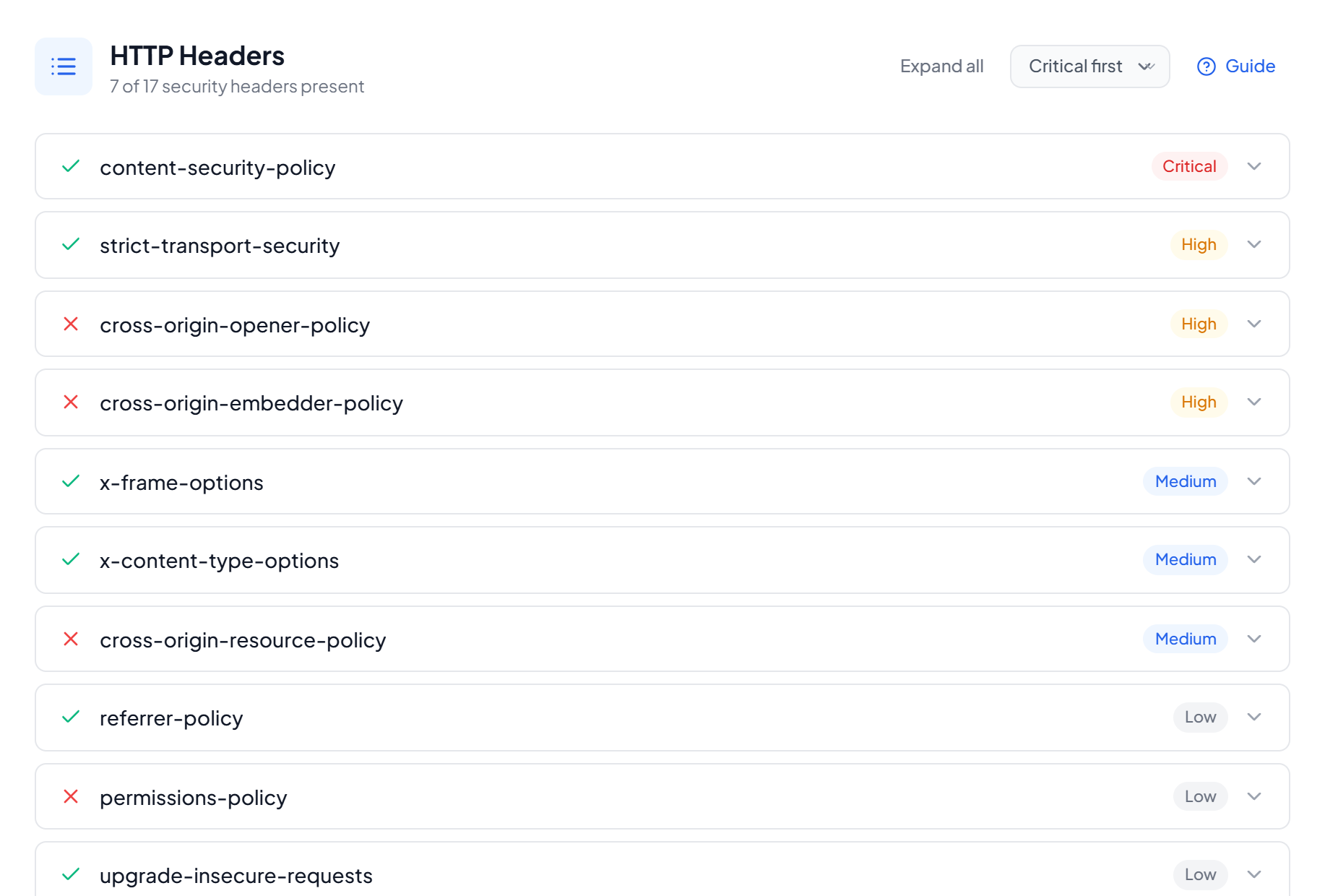
Every scan returns a clear letter grade, a category breakdown, and a prioritized list of findings with the exact fix for each. Download it as a PDF to share or attach to a compliance review.
How to check security headers of a website
Running a security headers check takes just a few seconds. No installation, no browser extensions, no developer tools required.
Enter your URL
Type or paste any website address into the scan input above. We accept domains with or without the protocol prefix.
Get your analysis
Our scanner fetches the HTTP response, evaluates security headers, TLS settings, DNS records, and cookies, then assigns a security headers grade.
Fix the issues
Review the detailed findings and follow the step by step recommendations to improve your security headers score.
Why use our security headers checker
Most free online security headers scanners only check whether a handful of headers exist. SiteSecurityScore provides a comprehensive security headers test that covers your entire attack surface.
Checks 15+ security headers
Goes beyond the basics to cover CSP, HSTS, COEP, COOP, CORP, Permissions-Policy, and more.
Analyzes beyond just headers
Includes TLS/SSL, DNS records, cookie attributes, and CORS configuration in one scan.
Actionable fix recommendations
Every finding comes with a clear explanation and step by step instructions to resolve it.
Free with no registration
Run unlimited scans without creating an account. No credit card, no trial period.
PDF export available
Download a professional report to share with your team or include in compliance documentation.
Security headers reference
These are the key HTTP security headers that every website should implement. Our content security policy checker and HSTS header check cover all of them in a single scan.
| Header | Purpose |
|---|---|
| Content-Security-Policy | Controls which resources the browser is allowed to load, preventing XSS and data injection attacks. |
| Strict-Transport-Security | Forces browsers to use HTTPS for all future requests to your domain. |
| X-Frame-Options | Prevents your site from being embedded in iframes, blocking clickjacking attacks. |
| X-Content-Type-Options | Stops browsers from MIME-sniffing responses, reducing drive-by download risks. |
| Referrer-Policy | Controls how much referrer information is sent with requests leaving your site. |
| Permissions-Policy | Restricts access to browser features like camera, microphone, and geolocation. |
| Cross-Origin-Embedder-Policy | Requires resources to explicitly grant permission to be loaded, enabling cross-origin isolation. |
| Cross-Origin-Opener-Policy | Isolates your browsing context from cross-origin popups to prevent Spectre-style attacks. |
| Cross-Origin-Resource-Policy | Controls which origins can load your resources, adding another layer of isolation. |
Frequently asked questions
What is a security headers checker?
A security headers checker is a tool that scans a website's HTTP response headers to verify whether important security headers like Content-Security-Policy, Strict-Transport-Security, X-Frame-Options, and others are present and correctly configured. It helps identify gaps that could leave your site vulnerable to attacks such as cross-site scripting (XSS), clickjacking, and data injection.
Which security headers should my website have?
At a minimum, your website should include Content-Security-Policy (CSP), Strict-Transport-Security (HSTS), X-Content-Type-Options, X-Frame-Options, Referrer-Policy, and Permissions-Policy. For additional protection, consider adding Cross-Origin-Embedder-Policy (COEP), Cross-Origin-Opener-Policy (COOP), and Cross-Origin-Resource-Policy (CORP).
How do I check my website's security headers for free?
Enter your website URL in the scan input above and click Scan. SiteSecurityScore will analyze your HTTP security headers, TLS configuration, DNS security records, and cookie attributes, then return a detailed report with a letter grade and actionable recommendations. No account or payment is required.
What is a good security headers score?
A good security headers score is an A or A+. This means your site has all the critical security headers properly configured. A grade of B indicates minor gaps, while C or below suggests significant headers are missing. SiteSecurityScore assigns letter grades from A+ to F based on header presence, configuration quality, and overall security posture.
Do security headers affect SEO?
Security headers do not directly influence search rankings, but they contribute to overall site trustworthiness. Google uses HTTPS as a ranking signal, and HSTS ensures browsers always connect over HTTPS. A site with strong security headers also reduces the risk of defacement or malware injection, which can lead to search engine penalties or blacklisting.
Can I check security headers without developer tools?
Yes. Instead of manually inspecting headers in browser developer tools, you can use an online security headers checker like SiteSecurityScore. Just enter a URL and the tool fetches, parses, and grades the response headers for you, along with clear explanations and fix recommendations for each issue found.
Start your free security headers check
Enter any URL and get a comprehensive security analysis covering headers, TLS, DNS, and cookies. No signup required, no limits on scans.
Scan your website now